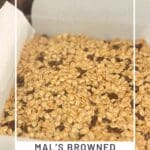
Mal’s Browned Butter Sourdough Granola Bars
These browned butter sourdough granola bars are that something. They're chewy without being gummy, hold together when you bite into them, and have this deep, nutty complexity that makes people ask what's in them.
Servings: 12 pieces
Calories: 264kcal
As an Amazon Associate I earn from qualifying purchases.
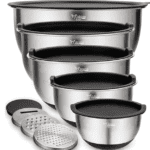
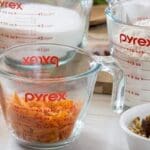
Equipment
Ingredients
- ½ Cup Unsalted Butter browned, (113 grams)
- ⅓ Cup Sourdough Discard + 1 Tablespoon (100 grams)
- ¼ Cup Honey (85 grams)
- 2 Tablespoons Brown Sugar (30 grams)
- 1 Teaspoon Vanilla Extract (4 grams)
- 1¼ Teaspoons Salt (7 grams)
- 2¾ Cups Old-Fashioned Rolled Oats (240 grams)
- 1 Cup Chocolate Chips chopped nuts, dried fruit, or a combination
Instructions
- The magic starts with butter that's been pushed past golden into actual brown territory. Put half a cup of unsalted butter in a saucepan over medium heat. Let it melt completely, then keep going. You're watching for two things: those little golden brown bits forming on the bottom of the pan and that unmistakable nutty, almost toasty smell that fills your kitchen. Stir occasionally with a whisk so you can see what's happening at the bottom. The moment it smells like heaven and looks deeply amber, pull it off the heat. If those bits turn black, you've gone too far and the flavor turns bitter instead of rich.½ Cup Unsalted Butter
- While the butter cools slightly, preheat your oven to 325°F and line a 9 x 9-inch baking pan with parchment paper. Leave enough overhang on two sides so you can lift the whole block out later without wrestling with a spatula.
- Now grab a large mixing bowl and combine the browned butter with your sourdough discard, honey, brown sugar, vanilla extract, and salt. Whisk it until the discard fully dissolves into the mixture and everything looks smooth. This is where the sourdough tang gets distributed evenly, so don't rush this step.⅓ Cup Sourdough Discard, ¼ Cup Honey, 2 Tablespoons Brown Sugar, 1 Teaspoon Vanilla Extract, 1¼ Teaspoons Salt
- Add your rolled oats and whatever mix-ins you're using. Fold everything together with a silicone spatula until every oat is coated. The mixture should look sticky and clumpy, not dry.2¾ Cups Old-Fashioned Rolled Oats, 1 Cup Chocolate Chips
- Transfer the whole mess into your prepared pan. Use your spatula or another piece of parchment paper and press down firmly until the surface is completely even and compacted. The tighter you pack it now, the less it crumbles later when you're trying to eat one in the car.
- Bake for about 25 minutes, just until the edges start turning lightly golden. The center might still look a little soft, and that's fine. It firms up as it cools.
- Let the pan sit on the counter for 15 minutes, then move the whole thing to the fridge. The cold is what locks everything into place. Once it's fully chilled and firm, lift it out using the parchment overhang and slice into bars.
Notes
Tips from our Kitchen
- Use a light-colored pan for browning butter. Dark pans hide the color change, and you'll end up with burnt butter before you realize what happened. Stainless steel or light nonstick lets you see exactly when those milk solids hit peak toastiness.
- Weigh your oats instead of measuring by volume. Cups of oats can vary wildly depending on how packed they are. 240 grams gets you consistent results every time, and the bars hold together better when the oat-to-wet ratio is precise.
- Press the mixture while it's still warm. Cold mixtures resist compression. If you press while everything is just warm enough to be pliable, you get a denser, more cohesive bar that won't fall apart when you cut it.
- Chill before slicing, always. Room-temperature bars slice like a disaster. Cold bars slice clean with a sharp knife, and you can wipe the blade between cuts for bakery-level edges.
Nutrition
Calories: 264kcal | Carbohydrates: 30g | Protein: 4g | Fat: 15g | Saturated Fat: 8g | Polyunsaturated Fat: 1g | Monounsaturated Fat: 4g | Trans Fat: 0.3g | Cholesterol: 22mg | Sodium: 41mg | Potassium: 170mg | Fiber: 3g | Sugar: 13g | Vitamin A: 245IU | Vitamin C: 0.1mg | Calcium: 24mg | Iron: 2mg