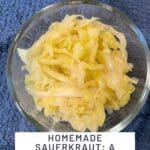
Homemade Sauerkraut: A Simple Way to Preserve Cabbage
A simple fermented homemade sauerkraut made with just 2 ingredients; fresh cabbage and salt.
If you have ever grown more cabbage than your family can eat fresh, homemade sauerkraut is a wonderful way to preserve it. With just cabbage and salt, you can turn a fresh garden harvest into a tangy fermented food that keeps for months in the refrigerator.
Servings: 2 quarts
Calories: 156kcal
As an Amazon Associate I earn from qualifying purchases.
Equipment

Ingredients
- 1 Large Head Cabbage about 5 pounds
- 3 Tablespoons Canning Salt weigh your prepared cabbage and calculate the salt — 2% of the weight of the prepared cabbage
Instructions
- Prepare the cabbage. Remove any damaged outer leaves. Save two large, clean outer leaves for later. Cut the remaining cabbage into quarters and remove the core.1 Large Head Cabbage
- Slice the cabbage. Slice each quarter into strips approximately 1/8 inch thick and no longer than 3 inches. Place the shredded cabbage in a large bowl.
- Weigh the cabbage. Weigh the prepared cabbage and calculate 2% of its weight. Use that amount of canning salt. For example, 5 lb cabbage = 2,268 g of cabbage requires 45 grams of salt (3 Tablespoons).
- Add the salt. Sprinkle the calculated amount of salt over the cabbage. Let it rest for at least 10 minutes.3 Tablespoons Canning Salt
- Massage the cabbage. Using clean hands, massage and squeeze the cabbage until it becomes soft and translucent and releases plenty of liquid. The liquid will become the natural brine.
- Pack the jars. Using clean tongs, add a few inches of cabbage to a wide-mouth quart jar. Firmly tamp it down with a wooden spoon or tamper to remove air pockets and bring the brine up around the cabbage. Continue adding and tamping the cabbage until the jar is nearly full, leaving room for the cabbage leaf and fermentation weight. Repeat with the second jar.
- Add the cabbage leaf. Place one of the saved cabbage leaves over the shredded cabbage. Trim it to fit the jar with a slight overhang. Gently press the leaf down so it is beneath the brine. Repeat for the second jar.
- Add the fermentation weight. Place a fermentation weight on top of the cabbage leaf, making sure the cabbage remains submerged beneath the brine.
- Cover the jars. Place a fermentation breather lid on each jar and secure with a jar ring.
- Ferment. Place the jars in a clean location away from direct sunlight. A temperature around 70–75°F is generally suitable for fermentation. Allow approximately 3–4 weeks, depending on temperature and your desired flavor.
- Check the sauerkraut. Begin tasting around three weeks. Use a clean fork to reach beneath the cabbage leaf and take a small amount. If you like the flavor, fermentation is complete. For a stronger sour flavor, allow it to ferment another week or two.
- Refrigerate. Once the sauerkraut has reached the flavor you like, transfer it to the refrigerator. Keep the cabbage covered with brine and use a clean utensil when serving.
Notes
Important Fermentation Notes
Fermentation Time
Approximately: 3–4 weeks at 70–75°F Fermentation time can vary depending on temperature and personal preference.- A cloudy brine can occur during fermentation and does not necessarily indicate spoilage.
- A sour, fermented aroma is expected.
- If the sauerkraut develops a rotten, rancid, or distinctly unpleasant odor, significant mold, or unusual discoloration, discard it without tasting.
- Do not reduce the salt simply to make the finished sauerkraut less salty. Salt is an important part of the fermentation process.
- 5 lb cabbage = 2,268 g
- 2% of 2,268 g = 45.36 g salt
- Fine canning/pickling salt ≈ 15 g per tablespoon, so 45 g ≈ 3 tbsp
Equipment
For this recipe, use:- Wide-mouth quart jars
- Glass fermentation weights or alternative food-safe weight source
- Fermentation breather lids or alternative food-safe method
- Jar rings
Nutrition
Calories: 156kcal | Carbohydrates: 36g | Protein: 8g | Fat: 1g | Saturated Fat: 0.2g | Polyunsaturated Fat: 0.1g | Monounsaturated Fat: 0.1g | Sodium: 10577mg | Potassium: 1063mg | Fiber: 16g | Sugar: 20g | Vitamin A: 612IU | Vitamin C: 228mg | Calcium: 256mg | Iron: 3mg